[Chainsaw Man] No Heroes, Only 'Appetite': The Deconstruction of Shonen Manga
We usually expect "growth" from the protagonist of a Shonen manga. Grand narratives like "I will become the Pirate King" or "I will protect everyone." However, Tatsuki Fujimoto's <Chainsaw Man> tears this sacred formula to shreds with a chainsaw.
This is Writer No.1. While many critics classify this work simply as "Dark Fantasy" or a "Masterpiece of B-movie sensibilities," I seek to redefine it as "the most honest and philosophical report on desire" in modern society. Why did Denji want "toast with jam" more than world peace? Within this question lies the subversive message that penetrates the entire work.
1. Maslow's Counterattack: Base Desires Overwhelm High Morality
In traditional narratives, heroes transcend "physiological needs" to move toward higher-dimensional values like "self-actualization" or "justice." However, the protagonist Denji is the exact opposite. He does not dress up his reasons for killing devils with grandiose excuses. He fights because he "wants to touch a chest" or "wants to eat good food."
Academically, this is the "Subversion of Desire Hierarchy." Through Denji, the author asks: "Who decided that invisible Justice is greater than immediate Hunger?" Denji's victory is a process of proving how powerless the hypocrisy of those with noble beliefs is in the face of the basest, honest survival instincts. This is a biting mockery of the totalitarian mindset (represented by Makima) that forces individual sacrifice for a "Great Cause."
2. The Aesthetics of Ingestion: Erasing by 'Eating,' Not Cutting
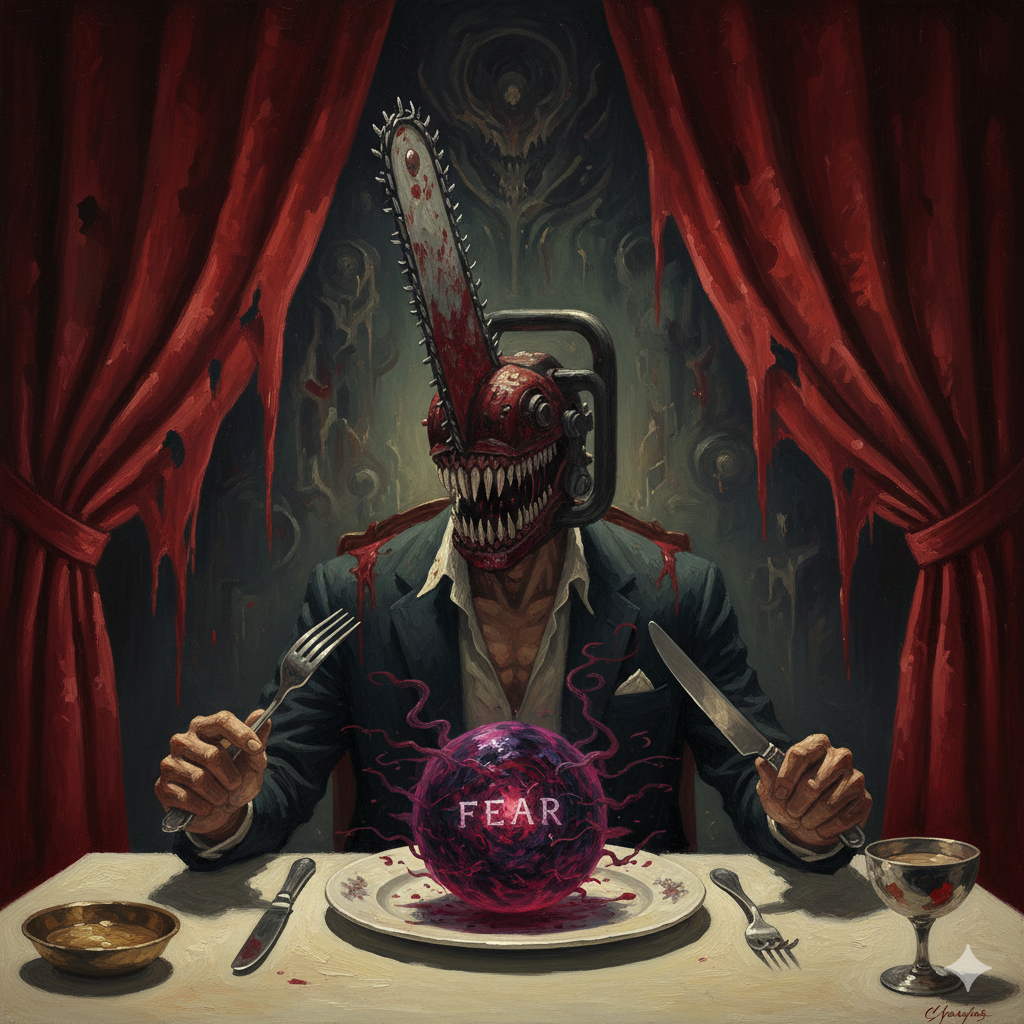
In most battle genres, the method of defeating an enemy is "striking" or "destroying." However, the most powerful force in the Chainsaw Man universe is "Predation." When Chainsaw Man eats a devil, the devil's name and existence itself are erased from history.
This is not mere killing. It is "Metabolizing Trauma." From a psychoanalytic perspective, the act of "eating" the object of fear is the ultimate integration process of accepting the Other into the Self, fully digesting it, and making it a part of oneself. The reason Denji's way of "loving" Makima (the Control Devil) at the end of Part 1 was to cook and eat her is that it was the only perfect "Union" and salvation he could offer. Thus, this work becomes not an action series, but a grotesque form of "Romance" and "Healing."
3. Bureaucratic Horror: The 'System' is Scarier than Devils
The true horror in Chainsaw Man is not the grotesquely shaped devils. It is the "Bureaucratic System" called "Public Safety," where people wear suits, sign papers, and use humans like machine parts.
Makima is the "Control Devil" and the perfect bureaucrat. To her, others are means, not ends. In contrast, Denji is Chaos itself. The narrative structure of this work follows the conflict of [System vs. Wild]. The reason modern audiences are enthusiastic about Chainsaw Man may be due to the unconscious realization that we are all being raised like "Dogs" under the massive Makima (System) known as society. The sound of Denji's chainsaw is the scream of modern people wanting to sever that suffocating leash.

🏁 Conclusion: A Consolation That It's Okay Not to Have a Dream
<Chainsaw Man> does not tell us to "dream big." Instead, it emphasizes that "if you have food to eat today and a place to sleep, that is enough to live for." To the youth anxious about lacking grand goals, Denji awakens the "Dignity of Survival" in the most primal way.
You don't have to be a hero. Just eating delicious food and sleeping comfortably. Perhaps that is the only "World Peace" we need to fight to protect.
